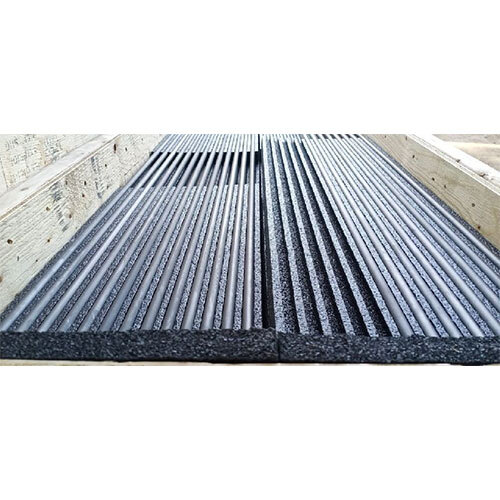
Our Cross-Flow Filtration Systems are engineered to continuously separate particles without clogging the membrane, thanks to their tangential flow mechanism. These systems are perfect for continuous processing of fluids in large volumes.
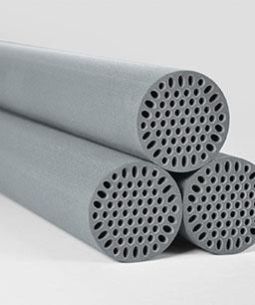
Tubular crossflow filters are used for the clarification of wine and for the treatment of industrial effluents, among other applications. Source: Saint-Gobain Performance Ceramics & Refractories
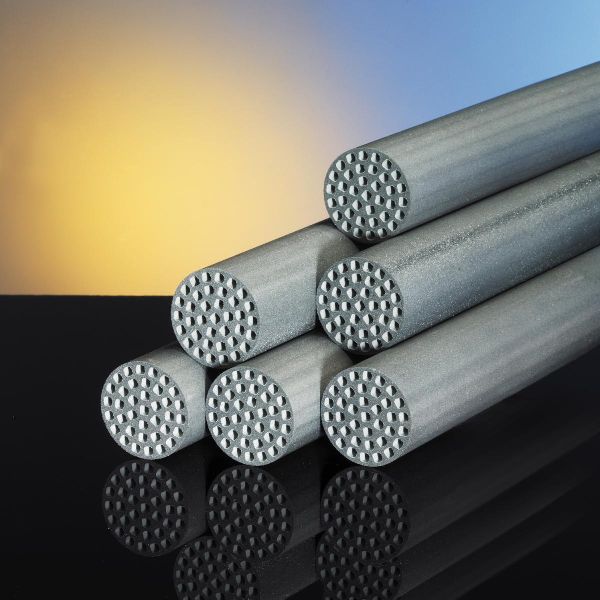
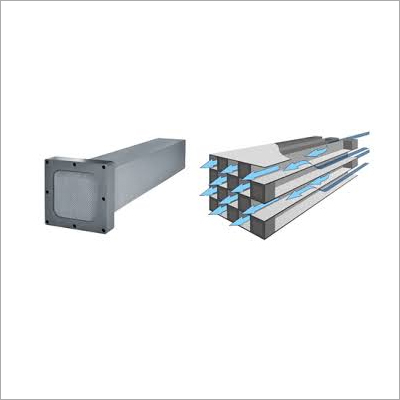
• Crossflow filtration uses a selective porous membrane that filters highly loaded liquids for purification or clarification. Tubular crossflow filters have been used for the clarification of wine, along with the filtration of dairy, fruit juices and water, for chemical recovery and for the treatment of challenging industrial effluents.
• Crossflow filtration gets its name because the majority of the feed flow travels longitudinally along the surface of the filter channels, whereas the filtered permeate flows radially through the carrier porosity. The structure of the traditional crossflow filters is tubular and consists of a carrier that is the base material, and on top of it is the filtration membrane, which is a thin, porous layer applied on the carrier.
Applications: Wine clarification, Protein concentration, or Industrial wastewater recycling
Filtration Features:
| Filtration Type | Cross-Flow |
| Filter Membrane | Polymeric Or Ceramic |
| Shape | Round |
| Surface Finish | Polished |
| Recovery Rate | 70 – 90% |
| Filtration Size | Fine To Ultrafine Particle |
| Flow Rate | Up To 500 Liters Per Hour (varies By Model) |
| System Type | Modular |
| Application | Ideal For Continuous Filtration |
| Operating Pressure | Up To 50 Psi |
| Flow Direction | Perpendicular To Filter Surface |
| Size Option | Multiple Sizes |
| Cleaning Method | CIP (Clean-in-place) Compatible |
| Usage | Pharmaceuticals, Protein Concentration, Or Industrial Wastewater |
| Maintenance Required | Easy Filter Replacement |
| Exporter By | Jay Corro Plast |
| Country Of Origin | India |